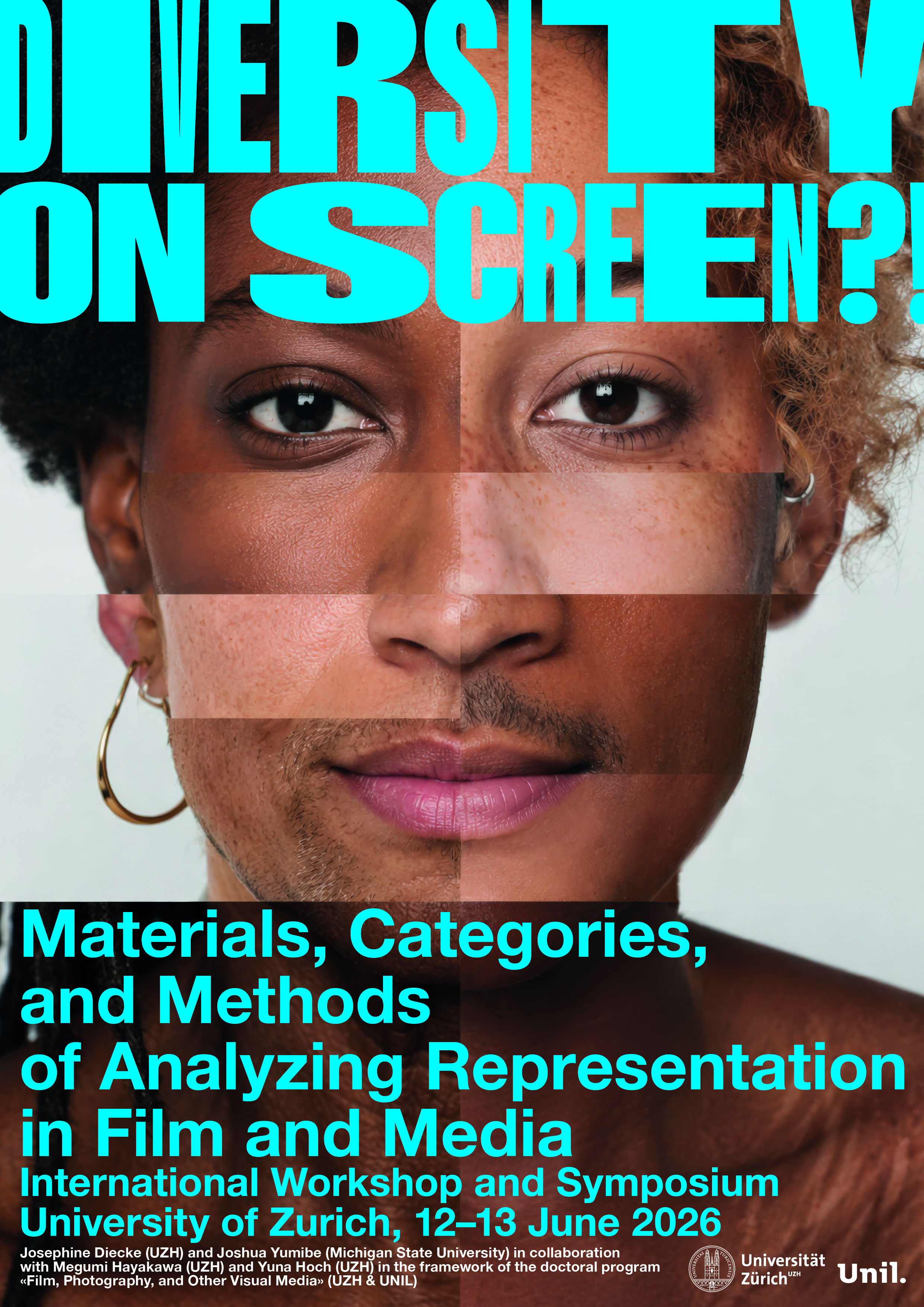
Diversity on Screen?!
Materials, Categories, and Methods of Analyzing Representation in Film and Media
Film Studies Workshop and Symposium, 12–13 June 2026
Recent debates on diversity, equity, and inclusion (DEI) – here framed through historically situated and methodologically operationalized categories such as gender, race, class, disability, sexuality, and age – have increasingly relied on empirical measurements and categorizations to render discrimination in film production and representation visible and intersubjectively analyzable. Many of these approaches – often loosely inspired by formats such as the Bechdel-Wallace test – focus on relatively small film corpora within specific national or economic contexts. Examples include Martha M. Lauzen’s It’s a Man’s (Celluloid) World (2024), the Austrian Film Institute’s Dritter Österreichischer Film Gender Report (2024), and the German study Audiovisuelle Diversität? Geschlechterdarstellungen in Film und Fernsehen in Deutschland (2017). In Switzerland, these discussions have been intensified by the studies Gleichstellung im Schweizer Filmschaffen (2021) and the pilot study Diversity on Screen of Swiss Films (2025), both published by the Bundesamt für Kultur (BAK), Section Film.
While such initiatives provide important insights into structural inequalities – such as the persistent underrepresentation of women in the professional film industry despite gender parity in film education – they also expose fundamental methodological and epistemological tensions. By translating audiovisual representation into measurable categories, these approaches risk stabilizing historically contingent concepts of diversity while flattening cultural complexity, ambiguity, and specificity. At the same time, they raise the question of how diversity is not only analyzed but also produced through the methods, categories, and analytical frameworks applied – and to what extent the repeated circulation of such quantitative findings translates into sustained changes in institutional practices, rather than merely reaffirming existing modes of evaluation.
Taking these developments as a point of departure, the two-day event asks how film and media studies can critically engage with and expand current approaches to analyzing diversity on and off screen. How can diversity on screen be analyzed in ways that remain sensitive to historical conditions, aesthetic forms, and cultural differences? How stable or transferable are analytical categories across different film cultures and media environments? And how can empirical and computational approaches be meaningfully combined with the critical, context-oriented, and interpretive perspectives central to film and media studies?
The PhD workshop on 12 June, led by Joshua Yumibe (Michigan State University), explores these tensions through the entanglement of aesthetics, technology, and materiality. The workshop invites participants to reflect on diversity as an analytical, methodological, and epistemic challenge in film and media studies. It is part of the doctoral curriculum at UZH, but participation is also open to others interested (please indicate your interests by email).
The symposium on 13 June extends this inquiry by examining how categories are constructed and operationalized across contexts in the analysis of audiovisual media. Through participant inputs and discussion, it seeks to foster an open exchange on materials, categories, and methods for analyzing representation in film and media, while exploring how scholars can contribute to more nuanced, historically grounded, and critically reflective approaches to studying diversity on screen beyond fixed taxonomies.
Concept and Organization: Josephine Diecke, Megumi Hayakawa and Yuna Hoch in the framework of the doctoral program «Film, Photography, and Other Visual Media», a joint initiative of the Department of Film Studies at University of Zurich and the Section d’histoire et esthétique du cinéma at the University of Lausanne. It is funded by the Graduate School of the Faculty of Arts and Social Sciences at UZH. The conference language is English and German.
Contact
If you have any questions or want to participate, please reach out to josephine.diecke@uzh.ch
Program
Friday, 12 June 2026
Kunsthaus Zürich
Heimplatz 1/5
8001 Zürich
|
10:00– |
MUSEUM VISIT |
University of Zurich / University Library
PFA-03-425 (afternoon) & PFA-00-422 (evening)
Pfingstweidstrasse 60, 8005 Zürich
|
12:30– |
LUNCH SCREENING OF SHORT FILM PROGRAM – Curated by Joshua Yumibe (Michigan State University) |
|
14:00– |
PHD WORKSHOP – Joshua Yumibe (Michigan State University) |
|
18:30– |
FILM SCREENING & DISCUSSION Salt & Pepper (NOR 2024, 80 min.) |
Saturday, 13 June 2026
University of Zurich / University Library
PFA-00-422
Pfingstweidstrasse 60, 8005 Zürich
|
09:00– |
ARRIVAL & COFFEE |
|
09:30– |
WELCOME – Josephine Diecke, Megumi Hayakawa, Yuna Hoch (UZH) |
|
09:50– |
PANEL 1 Chair: Megumi Hayakawa (UZH) |
|
11:00– |
BREAK |
|
11:15– |
PANEL 2 Chair: Joshua Yumibe (Michigan State University) |
|
12:45– |
LUNCH BREAK |
|
13:45– |
PANEL 3 Chair: Josephine Diecke (UZH) |
|
15:00– |
BREAK |
|
15:15– |
PANEL 4 Chair: Jelena Rakin (UZH) |
|
16:45– |
BREAK |
|
17:00– |
RESPONSE – Joshua Yumibe (Michigan State University) |
|
17:15– |
PANEL 5 – All participants |
|
18:15– |
APERO |